BT-104 (GS) – Basic Electrical and Electronics Engineering
December 2024•COMMON•SEMESTER-2
December 2024
Max Marks: 70
Duration: 3 Hours
Instructions:
• Attempt any five questions.
• All questions carry equal marks.
Q.1
a)Unit 1
What do you understand by dependent and independent sources? Explain with neat sketches. How can we convert a voltage source into a current source? Discuss.
AI Answer Available
Click to expandExpanded
b)Unit 1
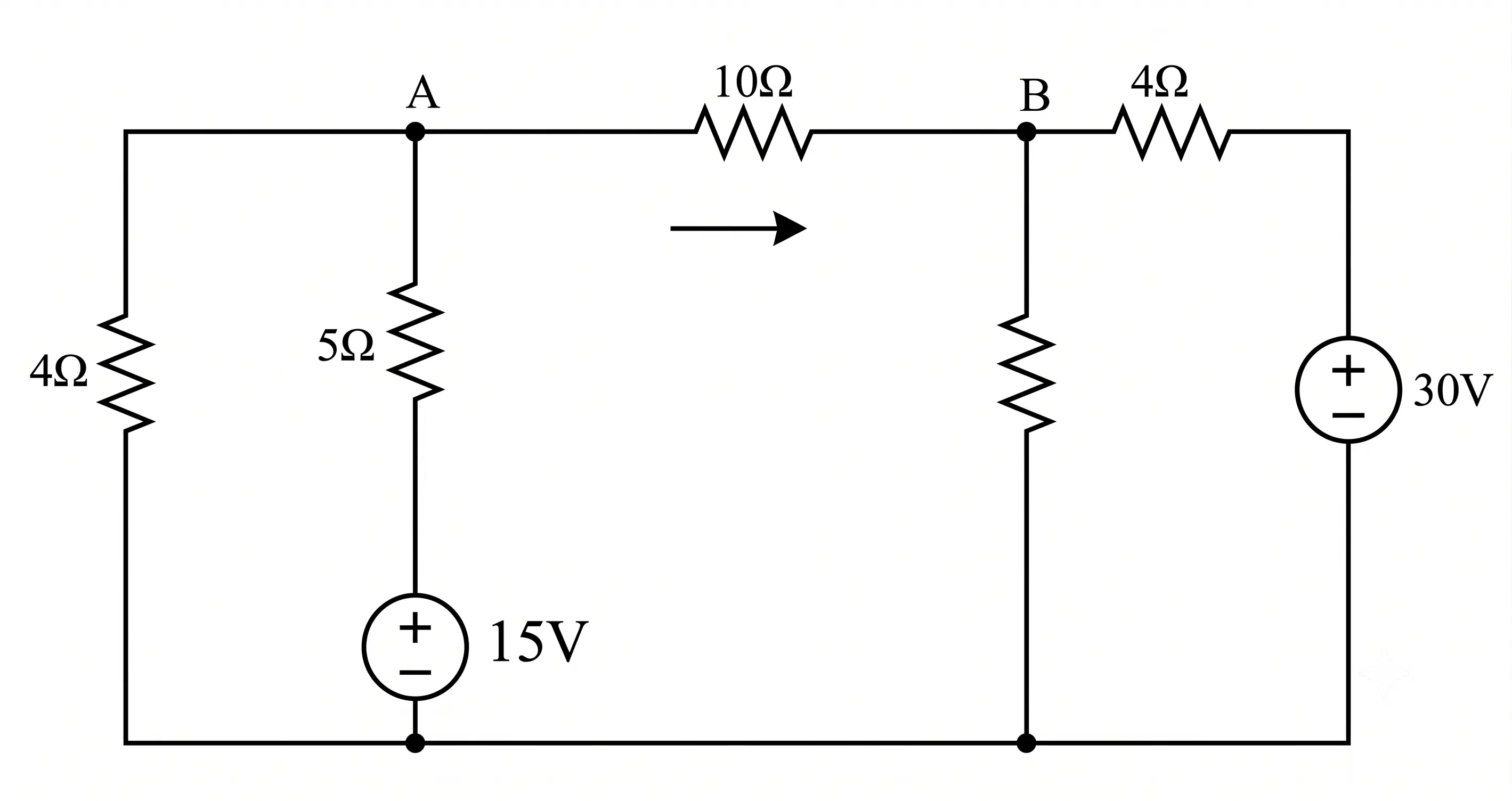
Using Nodal Analysis, find the current through the 10Ω resistor in the figure shown below.
Circuit Diagram
Figure for Question 1(b).
AI Answer Available
Click to expandExpanded
Q.2
a)Unit 1
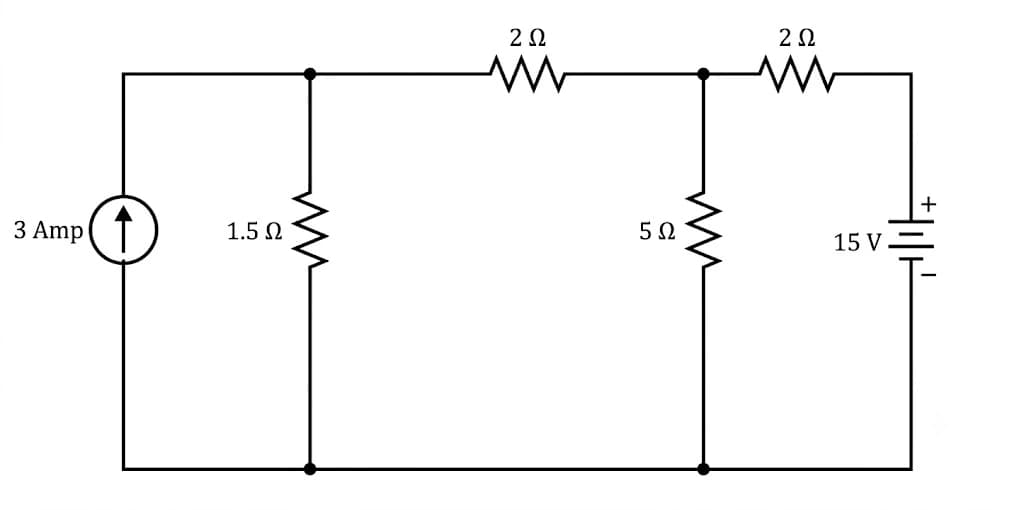
Find the value of current in branch AB using the Superposition Theorem. Refer to the circuit below.
Circuit Diagram
Figure for Question 2(a).
AI Answer Available
Click to expandExpanded
b)Unit 2
Define the average value, RMS value, form factor, and peak factor of an AC quantity. How are these parameters calculated for a sinusoidal waveform?
AI Answer Available
Click to expandExpanded
Q.3
a)Unit 2
A coil of resistance 10Ω and inductance 0.1H is connected in series with 150µF capacitor across a 200V, 50Hz supply. Calculate:
i) Inductive reactance,
ii) Capacitive reactance,
iii) Impedance,
iv) Current,
v) Power factor,
vi) Voltage across the coil,
vii) Voltage across capacitor.
AI Answer Available
Click to expandExpanded
b)Unit 2
A 3-Φ balanced system supplies 110V to a delta connected load whose phase impedance is (3.54 + j3.54)Ω. Determine the line current and draw the phasor diagram.
AI Answer Available
Click to expandExpanded
Q.4
a)Unit 3
What do you understand by self inductance and mutual inductance? Derive the relation between them.
AI Answer Available
Click to expandExpanded
b)Unit 3
Discuss the laws of electromagnetic induction.
AI Answer Available
Click to expandExpanded
Q.5
a)Unit 3
Open circuit and short circuit tests on a single-phase transformer gave the following results: V0=200V, I0=0.7A, W0=20W (Primary side), Vs=10V, Is=10A, Ws=40W (Secondary side). Determine the equivalent circuit parameters referred to the primary side.
AI Answer Available
Click to expandExpanded
b)Unit 4
Discuss the construction and working principle of a three-phase induction motor. Draw the torque-slip characteristics. Why can't this motor operate at synchronous speed?
AI Answer Available
Click to expandExpanded
Q.6
a)Unit 4
Describe a D.C. machine with suitable sketches, focusing on its main parts and construction details.
AI Answer Available
Click to expandExpanded
b)Unit 4
A three-phase 440V, 50hp, 50Hz induction motor delivers rated output at 1440 rpm. Calculate:
i) Number of poles,
ii) Synchronous speed,
iii) Slip,
iv) Slip rpm,
v) Rotor speed with respect to stator,
vi) Rotor EMF at operating speed.
AI Answer Available
Click to expandExpanded
Q.7
a)Unit 5
Solve for x:
i) (257)10 = (x)2,
ii) (21.625)10 = (x)8,
iii) (BC.2)16 = (x)8,
iv) (33)10 = (201)x.
AI Answer Available
Click to expandExpanded
b)Unit 5
With the help of input and output characteristics, explain the operation of a BJT in common emitter configuration.
AI Answer Available
Click to expandExpanded
Q.8
Unit 1/5/3/2
Write short notes on any two: a) Star Delta Transformation b) J-K Flip-Flop c) Magnetization Characteristics of Ferromagnetic Material d) Power in balanced and unbalanced three-phase systems