BT-104 (GS) – Basic Electrical and Electronics Engineering
June 2023•COMMON•SEMESTER-2
June 2023
Max Marks: 70
Duration: 3 Hours
Instructions:
• Attempt any five questions.
• All questions carry equal marks.
Q.1
a)Unit 1
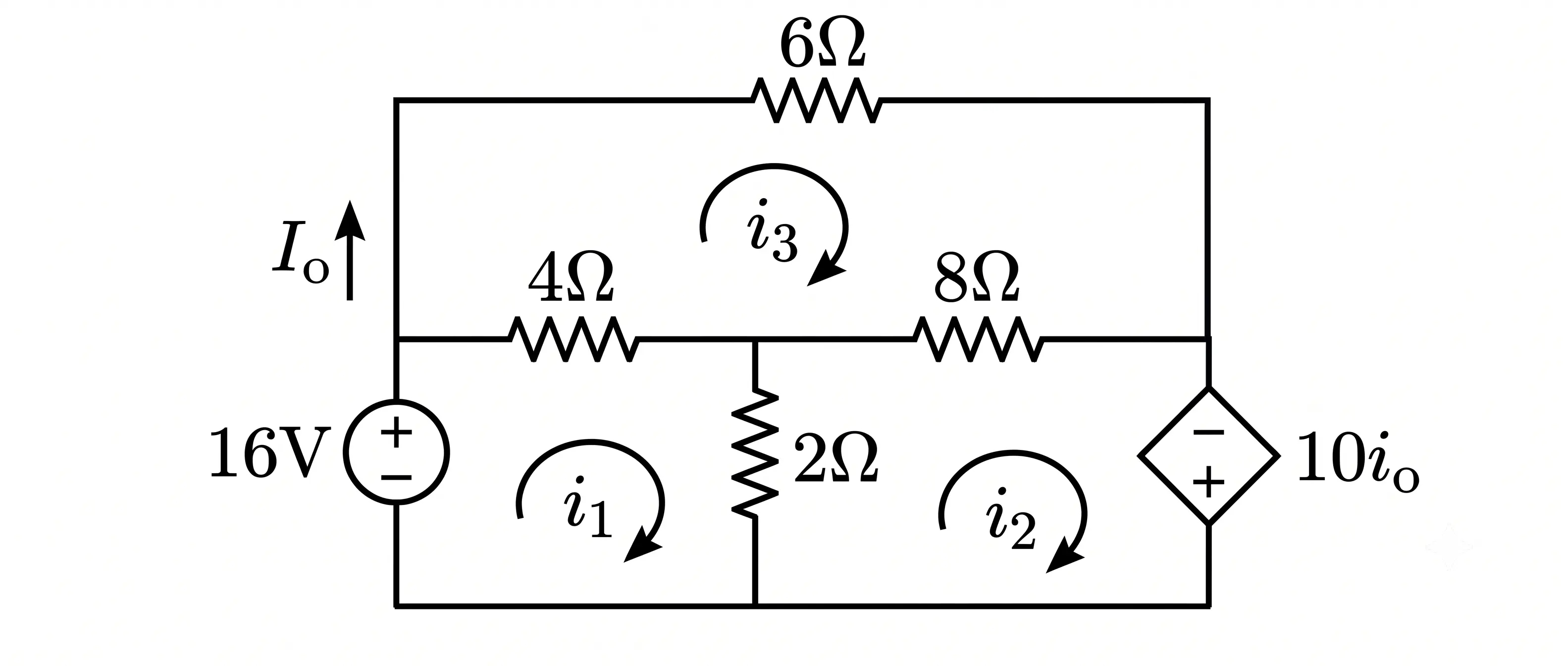
Using the mesh analysis, find the Io in the circuit as given below.
Circuit Diagram
Figure for Question 1(a).
AI Answer Available
Click to expandExpanded
b)Unit 1
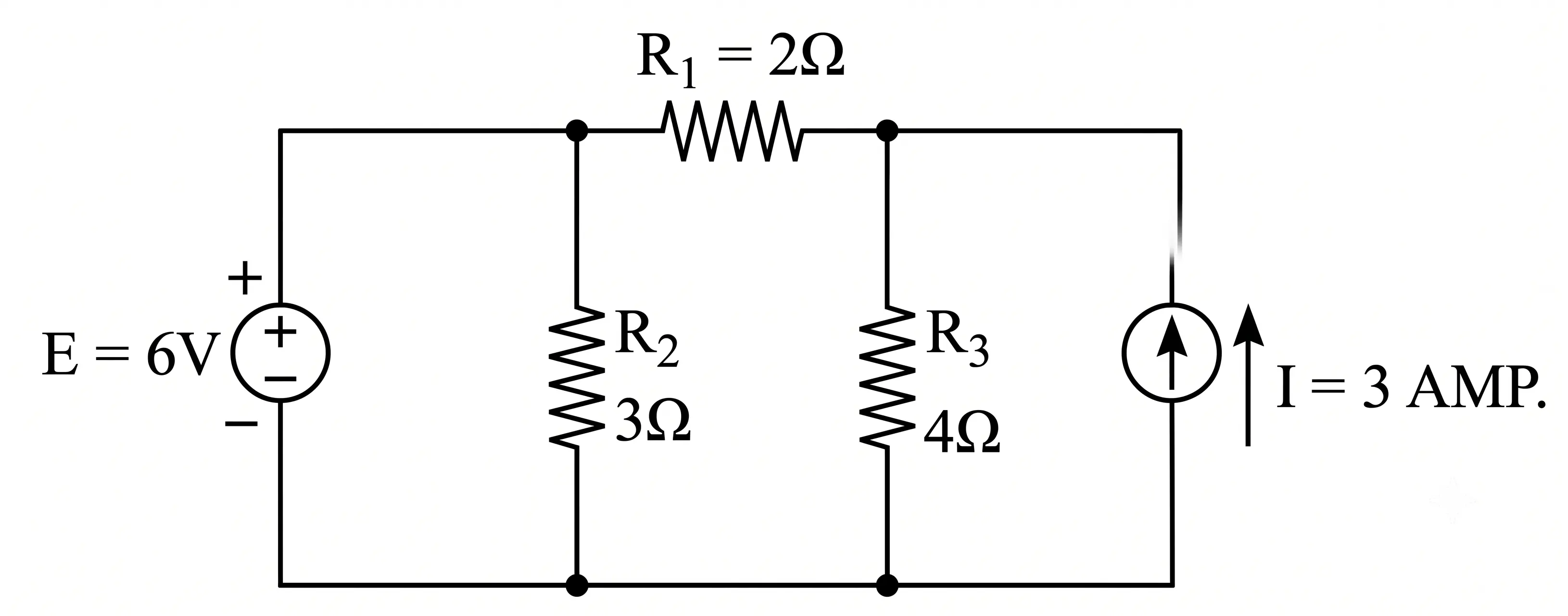
In the figure below, find the current flowing through R1 using Thevenin's Theorem.
Circuit Diagram
Figure for Question 1(b).
AI Answer Available
Click to expandExpanded
Q.2
a)Unit 1
What do you understand by Source. Discuss about different types of Dependent and Independent Voltage and current Sources with suitable sketch.
AI Answer Available
Click to expandExpanded
b)Unit 2
Define the following:
i) Alternating Quantity,
ii) R.M.S. Value,
iii) Average value,
iv) Form factor,
v) Peak factor.
AI Answer Available
Click to expandExpanded
Q.3
a)Unit 2
A coil having a resistance of 10 ohms and an inductance of 0.2H is connected in series with a 100×10⁻⁶ F capacitor across a 230V, 50Hz supply. Calculate:
i) The active and reactive components of the current,
ii) The voltage across the coil. Draw the phasor diagram.
AI Answer Available
Click to expandExpanded
b)Unit 2
A balanced star connected load of 8 + 6j ohm is connected across three phase, 50Hz, 440V supply system. Calculate:
i) Line current,
ii) Power absorbed,
iii) Reactive volt ampere.
AI Answer Available
Click to expandExpanded
Q.4
a)Unit 3
State the different types of transformers. Describe the construction and general principle of transformer.
AI Answer Available
Click to expandExpanded
b)Unit 3
What do you understand by Self inductance and mutual inductance? Derive the relation between Self inductance and Mutual Inductance.
AI Answer Available
Click to expandExpanded
Q.5
a)Unit 3
Open circuit and short circuit test on a single phase transformer gave the following results: V0=200V, I0=0.7A, W0=20 Watt Test from primary side. Vs=10V, Is=10A, Ws=40 Watt test from secondary side. Determine the equivalent circuit parameters referred to primary side.
AI Answer Available
Click to expandExpanded
b)Unit 4
Explain the construction and working principle of three phase induction motor with suitable diagram.
AI Answer Available
Click to expandExpanded
Q.6
a)Unit 4
A three phase, 6 pole, 50 Hz induction motor has a slip of 1% at no load and 3% at full load. Find:
i) Synchronous Speed,
ii) No Load Speed,
iii) Full Load Speed,
iv) Frequency of rotor current at full load.
AI Answer Available
Click to expandExpanded
b)Unit 4
Discuss about types of losses occurring in electrical machine.
AI Answer Available
Click to expandExpanded
Q.7
a)Unit 5
Draw and explain the V-I characteristics of a PN junction (Diode).
AI Answer Available
Click to expandExpanded
b)Unit 5
Draw the circuit and explain the characteristics of CB configuration.